Where Did the Masters of Art Gather in France?
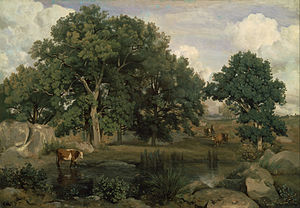

The Barbizon school of painters were role of an art movement towards Realism in art, which arose in the context of the dominant Romantic Motility of the time. The Barbizon school was active roughly from 1830 through 1870. It takes its proper noun from the village of Barbizon, France, on the edge of the Forest of Fontainebleau, where many of the artists gathered. Most of their works were landscape painting, but several of them likewise painted landscapes with farmworkers, and genre scenes of village life. Some of the most prominent features of this school are its tonal qualities, colour, loose brushwork, and softness of form.[1]
The leaders of the Barbizon school were: Théodore Rousseau, Charles-François Daubigny, Jules Dupré, Constant Troyon, Charles Jacque, and Narcisse Virgilio Díaz. Jean-François Millet lived in Barbizon from 1849, but his interest in figures with a landscape backdrop sets him rather apart from the others. Jean-Baptiste-Camille Corot was the earliest on the scene, first painting in the woods in 1829, but British fine art historian Harold Osborne suggested that "his work has a poetic and literary quality which sets him somewhat apart".[two] Other artists associated with the school, often pupils of the main group, include: Henri Harpignies, Albert Charpin, François-Louis Français, and Émile van Marcke.
Many of the artists were also printmakers, mostly in etching but the group too provided the bulk of the artists using the semiphotographic cliché verre technique. The French carving revival began with the schoolhouse, in the 1850s.[three]
History [edit]
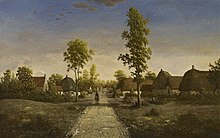
In 1824 the Salon de Paris exhibited works of John Constable, an English painter. His rural scenes influenced some of the younger artists of the time, moving them to carelessness formalism and to draw inspiration straight from nature. Natural scenes became the subjects of their paintings rather than mere backdrops to dramatic events. During the Revolutions of 1848 artists gathered at Barbizon to follow Constable's ideas, making nature the subject of their paintings. The French landscape became a major theme of the Barbizon painters.[four]

Millet extended the thought from landscape to figures — peasant figures, scenes of peasant life, and piece of work in the fields. In The Gleaners (1857), for example, Millet portrays three peasant women working at the harvest. Gleaners are poor people who are permitted to get together the remains after the owners of the field consummate the chief harvest. The owners (portrayed as wealthy) and their laborers are seen in the dorsum of the painting. Millet shifted the focus and the subject matter from the rich and prominent to those at the bottom of the social ladders.
In the spring of 1829, Jean-Baptiste-Camille Corot came to Barbizon to paint in the Forest of Fontainebleau, he had first painted in the wood at Chailly in 1822. He returned to Barbizon in the autumn of 1830 and in the summer of 1831, where he fabricated drawings and oil studies, from which he made a painting intended for the Salon of 1830; "View of the Forest of Fontainebleau'" (now in the National Gallery in Washington) and, for the salon of 1831, another "View of the Forest of Fontainebleau"'. While there he met the members of the Barbizon school: Théodore Rousseau, Paul Huet, Constant Troyon, Jean-François Millet, and the immature Charles-François Daubigny.[5]
During the tardily 1860s, the Barbizon painters attracted the attention of a younger generation of French artists studying in Paris. Several of those artists visited Fontainebleau Forest to paint the landscape, including Claude Monet, Pierre-Auguste Renoir, Alfred Sisley and Frédéric Bazille.[half dozen] In the 1870s those artists, amid others, developed the art motion called Impressionism and good plein air painting. In contrast, the chief members of the schoolhouse made drawings and sketches on the spot, but painted back in their studios.[7]
The Postal service-Impressionist painter Vincent van Gogh studied and copied several of the Barbizon painters equally well, including 21 copies of paintings by Millet. He copied Millet more than than any other artist. He as well did three paintings in Daubigny's Garden.
Both Théodore Rousseau (1867) and Jean-François Millet (1875) died at Barbizon.
Influence in Europe [edit]

Painters in other countries were also influenced by this art. Get-go in the tardily nineteenth century, many artists came to Paris from Austro-hungarian empire to study the new movements. For instance, the Hungarian painter János Thorma studied in Paris as a young homo. In 1896 he was one of the founders of the Nagybánya artists' colony in what is now Baia Mare, Romania, which brought impressionism to Hungary. In 2013 the Hungarian National Gallery opens a major retrospective of his piece of work, entitled, ''János Thorma, the Painter of the Hungarian Barbizon, viii February - 19 May 2013, Hungarian National Gallery[8]
Karl Bodmer, originally Swiss, settled in Barbizon in 1849. László Paál, some other Hungarian, lived in Barbizon in the 1870s.
Influence in America [edit]
The Barbizon painters also had a profound touch on landscape painting in the Usa. This included the evolution of the American Barbizon schoolhouse by William Morris Chase. Several artists who were also in, or contemporary to, the Hudson River Schoolhouse studied Barbizon paintings for their loose brushwork and emotional bear on. A notable example is George Inness, who sought to emulate the works of Rousseau.[9] Paintings from the Barbizon schoolhouse also influenced landscape painting in California. The artist Percy Gray carefully studied works past Rousseau and other painters which he saw in traveling exhibitions to inform his own paintings of California hills and coastline.[10] The influence of the Barbizon painters may be seen in the sporting dog paintings of Percival Rosseau (1859-1937), who grew up in Louisiana and studied at the Academie Julien.
Gallery [edit]
[edit]
- Eugène Boudin
- Hippolyte Boulenger
- Paul Cornoyer
- Gustave Courbet
- Pierre Emmanuel Damoye
- Constant Dutilleux
- Antonio Fontanesi
- Nicolae Grigorescu
- Winckworth Allan Gay
- H. I. Marlatt
- Adolphe Joseph Thomas Monticelli
- Paul Trouillebert
- Albert Charpin
- Charles Olivier de Penne
See likewise [edit]
- American Barbizon school
- Art colony
- Naturalism (fine art)
- Landscape fine art
- Macchiaioli
References [edit]
- ^ Craven, Wayne (1994). American Art: History and Civilisation. New York: Harry N. Adams, Inc. p. 332.
- ^ Osborne, 106-107, 107 quoted
- ^ Salsbury, Britany. "The Etching Revival in Nineteenth-Century France." In Heilbrunn Timeline of Fine art History. New York: The Metropolitan Museum of Art, 2014, online
- ^ Metropolitan Museum of Art timeline
- ^ Pomaréde, Vincent, Le ABCdaire de Corot et le passage français (1996), Flammarion, Paris, (ISBN 2-08-012466-8)
- ^ Heilbrunn Timeline, Metropolitan Museum of Fine art
- ^ Osborne, 107
- ^ János Thorma, the Painter of the Hungarian Barbizon, 8 Feb - 19 May 2013, Hungarian National Gallery
- ^ Bell, Adrienne (Dec 2012). "George Inness (1825–1894)". Metropolitan Museum of Art . Retrieved 18 September 2019.
- ^ Harrison, Alfred; Shields, Scott; et al. (1999). The Legacy of Percy Greyness. Carmel Art Clan. ISBN1885666098.
- Osborne, Harold (ed), The Oxford Companion to Art, 1970, OUP, ISBN 019866107X
Suggested sources [edit]
- Catalogues des Collections des Musees de France. Ministère de la civilisation. (Catalogs of Collections of Museums of French republic. Ministry of Culture.)
External links [edit]
-
 Media related to Barbizon Schoolhouse at Wikimedia Commons
 - Hecht Museum
- Cambridge Art Gallery
Source: https://en.wikipedia.org/wiki/Barbizon_school
0 Response to "Where Did the Masters of Art Gather in France?"
Post a Comment